WHY AI TABS BREAK IN DROP D AND OTHER TUNINGS
You run a song through an AI tab generator. You play the first bar. The notes are right — you can hear that much — but your hand is up at the ninth fret doing something no human wrote. The riff you know is played on an open low string is instead a barre in the middle of the neck.
Nothing is broken. The tab is in the wrong tuning, and a tab in the wrong tuning is a different instruction for the same music.
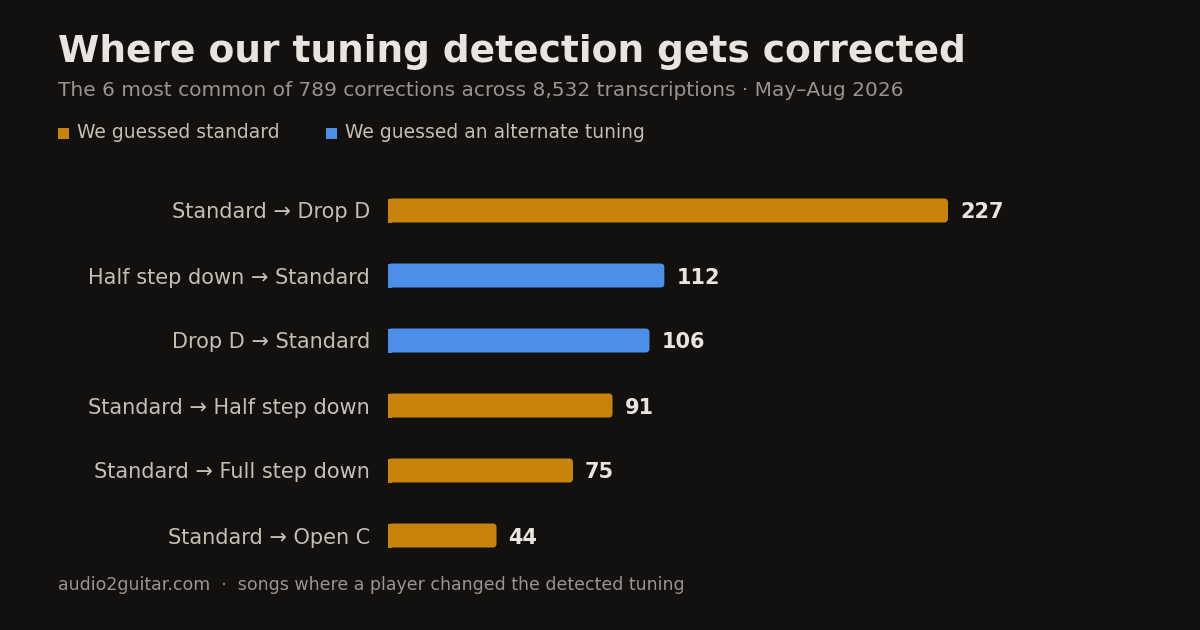
We can put numbers on how often this happens, because every time someone changes the tuning on a transcription we record what the pipeline guessed and what the player chose instead. Over three months that is 789 songs. Here is what those corrections look like, including the ones that make us look bad.
A TAB IS TWO THINGS, AND ONLY ONE COMES FROM THE AUDIO
Transcription finds pitches. That part is tuning-independent: a note at 82 Hz is a low E whether your sixth string is tuned to it or you are fretting it somewhere else.
Tablature is pitch plus a decision about where to play it— which string, which fret. That second half does not come from the audio at all. It comes from an assumption about how the guitar is tuned. Assume standard tuning for a song recorded in drop D and every note on that lowest string lands two frets higher than the guitarist actually played it.
This is the same reason a MIDI export is not a tab. MIDI has the pitches. It has no opinion about your fretting hand. If you have run into that, the MIDI versus tab comparison covers it in more detail.
Inside audio2guitar the tablature is stored in standard tuning, always, and remapped to whatever tuning the song is set to when it is drawn on screen. Changing the tuning does not re-transcribe anything and does not change a single pitch. It re-decides where those pitches sit on the neck. That is why the change is instant, and it is why getting the tuning right matters more than it sounds like it should.
WHAT 789 CORRECTIONS LOOK LIKE
In the three months to 5 August 2026 we completed 8532 transcriptions. On 789 of them — 9.2% — someone changed the tuning by hand.
Counting only the first change on each song, so that we are comparing against what the pipeline decided rather than against the player's own earlier pick:
| We guessed | The player chose | Songs |
|---|---|---|
| Standard | Drop D | 227 |
| Half step down | Standard | 112 |
| Drop D | Standard | 106 |
| Standard | Half step down | 91 |
| Standard | Full step down | 75 |
| Standard | Open C | 44 |
| Standard | Open G | 23 |
| Standard | Open D | 19 |
| Standard | DADGAD | 15 |
Rolled up: on 502 songs we said standard and the player disagreed. On 220 we named an alternate tuning and the player put it back to standard. On 67 we had an alternate tuning and they wanted a different one.
Both directions matter and we would rather say so than publish only the flattering half. Detection leans toward standard, which is the safe default and also the one that produces the most confidently wrong fingerings. And when it does commit to an alternate tuning it is wrong often enough — 220times — that “it said half step down” is not by itself a reason to believe it.
The number we would most like to have is the one we cannot see. 9.2% is how often somebody corrected the tuning. It is not how often the tuning was wrong. A player who did not notice, or who noticed and closed the tab, does not appear anywhere in that table. The true error rate is higher than 9.2% by some amount we cannot measure from this data. The running figures live on our public stats page.
THE GAP WE FOUND WHILE COUNTING
23 of those 789songs have the same shape, and it is our fault rather than the detector's.
The pipeline can identify drop C, drop C♯, drop B and drop A. The tuning selector does not offer them. So on those songs the analysis was right, and the player was handed a list that did not contain the answer. They picked the nearest thing — usually drop D, sometimes full step down — and got fingerings that are closer than standard but still not what was played.
23 songs is not a crisis. It is, however, exactly the kind of thing that stays invisible unless you go looking, because those users did not file anything. They shrugged and picked drop D. Adding the missing presets is the obvious fix and it is on the list.
FIXING IT ON YOUR OWN SONG
The tuning control sits above the tab. Change it and the fretboard redraws immediately — same notes, different positions. There are nine presets: standard, drop D, half step down, full step down, open G, open D, open C, open F, and DADGAD.
One honest limitation. When a tab is remapped into a tuning where some pitch has no open or low string available, that note has to go somewhere, and it ends up high on the neck. Most of the tab will snap into shape and a few notes may still look awkward. You can drag those individually.
WHICH TUNING IS IT, IF YOU DO NOT ALREADY KNOW
Usually you do — you looked the song up before you uploaded it. When you do not, these are the ones worth trying, in the order they are worth trying:
- Drop D— the single most common correction in our data by a wide margin. If the low riff sounds like it is being played with one finger across the bottom strings, try this first.
- Half step down, then full step down— if the song sounds like it is between keys against a standard-tuned guitar, or the vocal sits oddly low for the shapes you are seeing. Common across rock and metal recorded since the seventies.
- Open tunings and DADGAD— if the tab shows a lot of full-width barres where the recording sounds like open strings ringing. Slide playing, folk fingerstyle, and a good deal of acoustic songwriting.
- Drop C and below— the pipeline may spot these even though you cannot yet select them. Drop D gets you closest for now.
If the notes sound right and the shapes feel wrong, it is the tuning. That is nearly always what it is. For the vocabulary, the guitar tab glossary and the technique reference cover the rest of what shows up in a generated tab.
TRY IT ON SOMETHING YOU ALREADY KNOW
The fastest way to see whether any of this holds is to run a song you can already play. You will know within a bar whether the fingerings match what your hands do. If the song is one no catalogue has, learning a cover from the recording walks through the same workflow end to end.
Try it on your own song
UPLOAD SOMETHING YOU CAN ALREADY PLAY
You will know within a bar whether the fingerings match what your hands do. Three full songs free, no credit card.